


Eco-Friendly Dining: The Rise of Cornstarch Plates
2026-01-31 14:55
The Sustainable Revolution in Modern Tableware
As the world pivots toward a circular economy, the "disposable" culture of the past is undergoing a radical transformation. For decades, petroleum-based plastics dominated the food service industry, providing convenience at a massive environmental cost. Today, however, a new hero has emerged in the fight against pollution: Cornstarch-based materials.
Why Cornstarch is the Future of Dining
The shift toward cornstarch (often referred to as PLA or bio-based resins) isn't just a trend; it is a calculated response to both consumer demand and legislative pressure. Here is why this material is winning:
Biodegradability: Unlike traditional plastic which persists for centuries, cornstarch plates are designed to break down in industrial composting facilities, returning to the earth without leaving toxic residues.
Heat Resistance: Modern engineering has allowed these plates to withstand significant temperature ranges, making them suitable for both cold desserts and hot meals.
Low Carbon Footprint: The production of corn-based resin emits significantly fewer greenhouse gases compared to the extraction and refining of petroleum.
Non-Toxic Composition: These plates are free from BPA, phthalates, and other harmful chemicals that can leach into food when heated.
Understanding the Material: From Field to Fork
The journey of a cornstarch plate begins in the cornfield. The starch is extracted from the kernels and processed into dextrose. This dextrose is fermented into lactic acid, which is then polymerized to create Polylactic Acid (PLA). To enhance durability for heavy-duty use, manufacturers often blend this with other biodegradable fillers, creating a "bio-plastic" that feels premium and performs reliably.
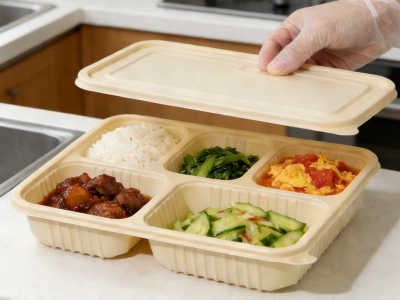
As seen in the provided images, the plate's cream-colored, natural hue reflects its organic origins. The embossed sunburst pattern isn't just for aesthetics; it provides friction to prevent food from sliding and strengthens the base against "soaking" through—a common flaw in lower-quality paper alternatives.
The Role of EEAT in Sustainable Product Sourcing
When sourcing for an independent brand or a catering business, Google’s EEAT guidelines suggest that users look for transparency and expertise.
Experience: Real-world testing (like the cake test in Image 51) proves the plate's load-bearing capacity.
Expertise: Understanding the chemical transition from starch to polymer ensures the product meets food-grade safety standards.
Authoritativeness: Choosing suppliers who comply with ISO and ASTM D6400 composting standards.
Trustworthiness: Providing clear information on how to dispose of the product properly.
Related News
Read More >-
![Degradable 5-Compartment Cornstarch Lunch Box]()
Degradable 5-Compartment Cornstarch Lunch Box
In January 2026, our design team launched a 5-compartment cornstarch lunch box globally to solve plastic pollution. This microwaveable, compostable container provides a high-performance, leak-proof solution for takeout.
-
![A Memorable Visit: American clientsExplores Sudihao's Capabilities, Fostering Promising Collaboration Through In-Depth Factory Tour]()
A Memorable Visit: American clientsExplores Sudihao's Capabilities, Fostering Promising Collaboration Through In-Depth Factory Tour
-
![Child-Safe Plastic Knife Making Kitchen Fun & Accessible!]()
Child-Safe Plastic Knife Making Kitchen Fun & Accessible!
-
![SUDIHAO Launches Custom Logo Labeling Packaging]()
SUDIHAO Launches Custom Logo Labeling Packaging
On June 18, 2026, SUDIHAO launched an advanced custom labeling and logo customization service for global food brands at its corporate facility to meet the surging demand for recognizable, eco-conscious, and branded food packaging solutions.
-
![SUNTIHO Launches Innovative Leak-Proof PP Bowl Series]()
SUNTIHO Launches Innovative Leak-Proof PP Bowl Series
In June 2026, SUNTIHO unveiled its groundbreaking leak-proof PP bowl series in China. Engineered with advanced co-extrusion technology, this line eliminates the need for sealing film, setting a new benchmark for food packaging safety, durability, and convenience.
-
![Sudihao Triumphs at the 139th Canton Fair]()
Sudihao Triumphs at the 139th Canton Fair
-
![Sudihao Debuts Durable Acrylic Dispenser Series]()
Sudihao Debuts Durable Acrylic Dispenser Series
Sudihao launched its premium Acrylic Sauce Dispenser series in April 2026, offering versatile 350ml to 600ml sizes for kitchens worldwide to enhance efficiency and style through durable design.
-
![Sudihao Unveils Innovative Gold PP Meat Trays]()
Sudihao Unveils Innovative Gold PP Meat Trays
In April 2026, Sudihao launched its premium gold PP material meat tray series globally to enhance food shelf life and presentation through advanced high-barrier molding and food-grade security.